Joseph Gunther
Where has ICE been arresting people in San Francisco?
Non-custodial arrests in and around SF in the first nine months of the second Trump administration
March 25, 2026
The analysis here was used extensively in two Mission Local articles: "Hidden from sight: new analysis shows half of local ICE arrests took place behind closed doors," and "Arrests behind closed doors: how ICE traps immigrants at routine appointments."
There are many fundamental questions about ICE actions during the second Trump administration that remain unanswered. One key source of insight has been anonymized individual-level data periodically released by ICE in response to a Freedom of Information Act lawsuit brought by the nonprofit Deportation Data Project. Researchers and journalists have repeatedly used this dataset to distinguish between custodial arrests (transfers of noncitizens from jails or prisons to ICE custody) and non-custodial arrests, and then count them over time, at the national, state, and local level. But non-custodial arrests can take many forms: arrests at immigration courts, arrests at ICE check-in appointments, arrests at USCIS asylum appointments, targeted arrests of specific people at their home or workplace, untargeted raids or sweeps, traffic stops, and more. Basic data on the frequency of these different types of arrest has been largely lacking (though nonpublic ICE records do usually contain enough information to precisely categorize arrests, specifically in the “narrative” portion of an ICE arrest’s corresponding I-213 reporting form, called a “Record of Deportable/Inadmissible Alien”). This report aims to categorize non-custodial arrests in and around San Francisco during the first nine months of the Trump administration, to gain a deeper understanding of arrest patterns and shifting ICE tactics. It is the first in a planned series of reports on different local jurisdictions.
In particular, this report finds that, from January 20 to October 15, there were very likely well over 500 arrests at check-in appointments and asylum appointments in San Francisco. These arrests are less public than courthouse arrests and community arrests, but ICE has quietly arrested far more people this way in San Francisco than via any other method. (This report estimates that there were somewhere from 879 to 1,022 non-custodial arrests in the San Francisco area in this timespan.)
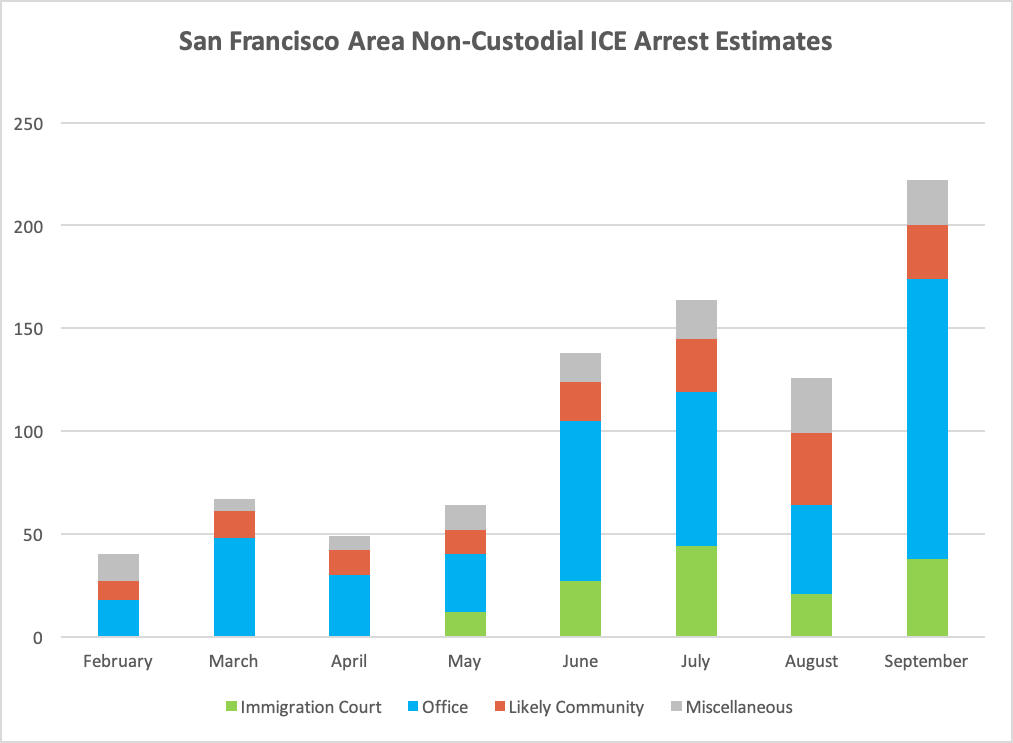
Furthermore, the results demonstrate shifting ICE priorities: through June, at least 45% of these identified office arrests were of people who had received a final removal order at some point (as determined by the Processing Disposition field of the encounters table). But starting in July, that proportion plummeted. While office arrests of immigrants with convictions did increase in the subsequent three and a half months, the majority of office arrests from July onward were of immigrants with neither final removal orders nor criminal records of any kind.
ICE’s rapid expansion of who was vulnerable to arrest was particularly stark in the context of immigration court arrests. Out of 147 people estimated to have been arrested at immigration court, only a single person had a criminal conviction of any kind: a DUI.
The Categories
The tables in the ICE dataset have many columns—besides arrest date, notable fields include Apprehension Method and Apprehension Site Landmark in the arrests table, and Final Program in both the arrests and detention-bookings table—but the values for them do not obviously distinguish between different types of arrest, with the exception of custodial vs. non-custodial arrests (custodial arrests generally have Apprehension Method values of “CAP Local Incarceration,” “CAP State Incarceration,” “CAP Federal Incarceration,” or “Custodial Arrest,” while non-custodial arrests usually have values like “Non-Custodial Arrest,” “Other efforts,” or “Located”). This report identifies nonobvious patterns for arrests in the San Francisco area that can be used to categorize most non-custodial arrests as courthouse arrests (henceforth meaning arrests at immigration court), office arrests (meaning arrests at the “check-in” appointments required of many noncitizens by ICE, or at USCIS appointments), or community arrests (arrests at homes, at workplaces, on the street, at probation offices, at non-immigration courthouses, etc.).
Identifying Patterns
In order to identify possible patterns in the data, I extensively reviewed news articles and federal habeas corpus lawsuits filed by immigrants challenging their detention. By comparing these to the ICE dataset, I was able to directly categorize a significant subset of 2025 San Francisco area arrests (over 10%).
In examining these “known” arrests, nontrivial patterns did in fact emerge for one of the data fields: while the Final Program values in the arrests table were very noisy, the Final Program values in the detention-bookings table were significantly more orderly. Of 59 known San Francisco courthouse arrests, 56 of them (95%) had a detentions Final Program value of “Non-Detained Docket Control” or “Alternatives to Detention.” Of 43 known office arrests with a detention-bookings trail starting in San Francisco, 40 of them (93%) had a detentions Final Program value of “Non-Detained Docket Control” or “Alternatives to Detention.” Of 15 known community arrests with a detention-bookings trail starting in San Francisco, 14 of them (93%) had a detentions Final Program value of “Fugitive Operations” (the outlier, which had a detentions Final Program value of “ERO Criminal Alien Program,” was unusual: the September arrest of a bystander during an ICE accompaniment of DEA agents who were executing a federal criminal search warrant at a home in Richmond, CA).
Caution: These patterns do not necessarily hold in other jurisdictions. In some areas that I’ve examined, they definitely don’t.
Distinguishing Courthouse Arrests from Office Arrests
Given these marked patterns, one can then try to extrapolate to categorize the larger set of San Francisco area arrests (I define the area somewhat loosely as San Francisco proper, San Mateo County, Alameda County, Marin County, and portions of Contra Costa County and Sonoma County). Before extrapolating, though, it’s necessary to separate courthouse arrests from office arrests, since they have overlapping Final Program values (“Non-Detained Docket Control” or “Alternatives to Detention”). To do this, I used a second dataset—individual-level anonymized immigration court data released monthly by the Department of Justice—to identify immigrants who’d had hearings and seemed likely to have been arrested afterward. (This method is a substantial refinement of earlier work of mine on identifying arrests at immigration courts.) These arrest candidates were identified either via detained dates recorded in the court data, or by DHS lawyers having moved to dismiss their case on the day of their court hearing. I then cross-checked the court-data arrest candidates against the ICE data, using basic information included in both datasets, such as nationality and birth year, for confirmation.
Ultimately, I was able to identify a set of 128 likely arrests at San Francisco immigration court, ranging from May 20 to October 2, which I believe to be close to complete. (As one important verification, the court-data method correctly identified 58 of the 59 known courthouse arrests as such. The only known courthouse arrest it missed was for a noncitizen who, in response to DHS moving to dismiss their case, had immediately requested and been granted voluntary departure by the immigration judge, but was still arrested upon leaving the courtroom. In this case, the initial motion to dismiss was not recorded in the court dataset. I manually included this arrest in the set of 128.) The Final Program pattern for San Francisco courthouse arrests was further confirmed: 125 of 128 of these arrests had a detentions Final Program of “Non-Detained Docket Control” or “Alternatives to Detention.”
There is also an immigration court in nearby Concord, CA. From my initial review, I only had two known Concord courthouse arrests in the data, both of which notably had a Final Program of “Fugitive Operations,” in contrast to San Francisco courthouse arrests. It seems likely that a different ICE sub-unit was performing these arrests than in San Francisco. I used the court data to identify a set of 19 total Concord courthouse arrests. Most of these (12 out of 19) had a detentions Final Program of “Fugitive Operations.” Regardless, they could now be separated out explicitly in the process of categorization.
Categorizing Non-Custodial Arrests
The categorization of non-custodial arrests in this report proceeded in several steps. The starting point was a list of detention stays beginning in the ICE San Francisco hold room, from January 20, 2025, to October 15, 2025, taken from the Deportation Data Project’s detention stays table. I manually added additional stays for 1) four seeming Concord courthouse arrests in which the detention stays began in the Stockton hold room, 2) three known San Francisco check-in arrests whose recorded detention stays in the data only began at a detention facility in Texas, and 3) twenty additional stays that did not start in the SF hold room but had an Apprehension Site Landmark value in the arrests table of either "SFR GENERAL AREA, NON-SPECIFIC" or "SAN FRANCISCO DISTRICT OFFICE." I excluded the second half of two stays that seemed to have been broken in two by transfers to and then back from criminal custody.
For each stay, I appended the Final Program value from the first stint in the detention stay (sometimes this value changes between stints when someone is reprocessed, but then the Final Program value seems to change to something less informative that only reflects that the person was detained when the reprocessing occurred, such as “Detained Docket Control” or “Detention and Deportation”). Whenever possible, I appended arrests-table information, such as Apprehension Site Landmark and Apprehension Method.
With that list of 1,181 detention stays in hand, I first labeled all the known arrests as: SF courthouse, Concord courthouse, office, or community arrests. I then labeled all additional suspected San Francisco and Concord courthouse arrests determined by matching with the immigration court dataset.
Next, I excluded all stays with disqualifying values in the Apprehension Site Landmark field of the arrests table. To begin restricting to non-custodial arrests, I excluded all arrests with a value indicating they were custodial arrests, such as “SOLEDAD CORRECTIONAL TRAINING FACILITY” or “US Marshals Service Oakland CA.” To restrict to the close San Francisco area, I also excluded a small number of arrests with a value of “SNJ GENERAL AREA, NON-SPECIFIC” (San Jose area) or “STO GENERAL AREA, NON-SPECIFIC.” Most California arrests with these values of Apprehension Site Landmark do not have corresponding detention stays starting in San Francisco, so it seemed appropriate to exclude the small number that did.
Next, I excluded detention stays that did not appear to have come from ICE arrests, because of a Final Program value of “Inspections - Air” (and one with “Inspections - Land”). I believe these to mainly be arrests at customs of international airport arrivals, who were then transferred to ICE custody from initial airport detention. To further exclude suspected custodial arrests, I then excluded any arrests with an Apprehension Method of “CAP Local Incarceration,” “CAP State Incarceration,” “CAP Federal Incarceration,” “Custodial Arrest,” or “Other Agency (turned over to INS)” and a Final Program value of either “ERO Criminal Alien Program” or “Fugitive Operations.”
At that point, I was done excluding arrests as likely custodial. Based on the patterns observed in the known arrests, I labeled as an office arrest any remaining unlabeled arrest with both 1) a Final Program value of “Non-Detained Docket Control” or “Alternatives to Detention” and 2) an Apprehension Method value that was blank or one of “Non-Custodial Arrest,” “Other efforts,” or “Located.” I labeled as a likely community arrest any remaining unlabeled arrest with both a Final Program value of “Fugitive Operations” and an Apprehension Method value that was blank or one of “Non-Custodial Arrest,” “Other efforts,” “Located,” or “Probation and Parole.”
Lastly, I labeled the remaining arrests as “miscellaneous.” These fell into two categories: a Final Program/Apprehension Method pair that was too ambiguous (such as “Alternatives to Detention”/“Other Task Force” or “Non-Detained Docket Control”/“Custodial Arrest” or “ERO Criminal Alien Program”/“Non-Custodial Arrest”), or just an ambiguous Final Program (such as “Detained Docket Control,” “Detention and Deportation,” or “Homeland Security Investigations”).
Ultimately, I obtained the following non-custodial arrest estimates for the period from January 20 to October 15: some 539 office arrests, 193 likely community arrests, 147 immigration court arrests (128 in San Francisco and 19 in Concord), and 142 miscellaneous arrests (some of which may have been custodial, and a small number of which may have been San Jose area arrests without distinguishing landmark information).
Confidence Discussion
I have the highest confidence in the immigration court arrest estimates and in the lower bound of 539 for office arrests. The community arrest estimate, based on having “Fugitive Operations,” is somewhat lower confidence, which is why I’ve called them “likely community” arrests. Given the smaller number of known community arrests I was able to gather, and the fact that the three known SF-stay check-in arrests with an outlier Final Program value were all “Fugitive Operations,” it does seem possible that the “likely community” number is something of an overestimate and the “office” number is something of an underestimate. That said, reporting from San Mateo County and the East Bay does seem to reflect a slow but persistent stream of community arrests there. Finally, there is the uncertainty coming from the minority of arrests I categorized only as miscellaneous, which may be non-custodial or custodial arrests.